Showing posts with label Somali Voices. Show all posts

29 August 2012

Solidarity Rally in the Park


Last Sunday (August 26) a public rally was held in the park outside the Hamburg remand prison where seven of the Somali defendants have been held for over two years, waiting for their verdict

One of the biggest wishes of the prisoners has always been to hear Somali music. They can't listen to their language on the radio like other prisoners and the rules around getting CDs into prison are tight – only CDs from certain suppliers are allowed and most Somali musician aren't signed up with major labels.


The solution therefore, was to play their music in the park. The open mike was used to greet the Somali prisoners and other people also used the opportunity to say hello to their relatives and friends.


The weather was fine, the waffles tasted great, the kids played on the grass and maybe the prisoners felt a little bit less lonely in their cells that day.

14 July 2012

The Confiscated Child - Fundraiser Booklet


The Confiscated Child

One of the accused in the Hamburg 'Piracy Trial' tells the story of how his child was kidnapped when he couldn't pay his debt. The booklet is a fundraiser to free his child. It is illustrated, hand-coloured and the 500 copies are individually numbered.


Available at Schanzenbuch book shop (Schulterblatt 55, 20357 Hamburg).
For bulk orders contact us at ReclaimTheSeas@googlemail.com

Price: €5.00

25 March 2012

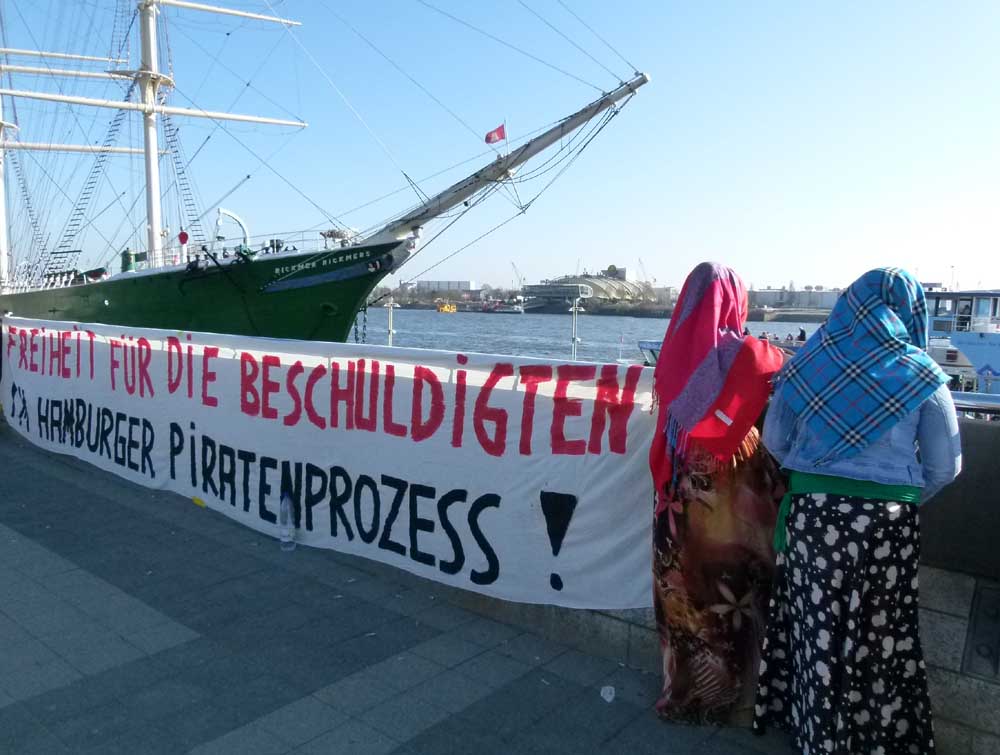
Somali Music in the Harbour

Today, Somali music could be heard at the Hamburg waterfront. This was the music, the ten accused in the trial would love to hear, but are having difficulty to get, due to the bureaucratic process of getting music into prison (the CDs have to come from a certified supplier, which are companies who don't usually carry Somali music).

The music was part of a rally with the slogan “Laden tables instead of armed conflicts”. The purpose was to draw attention to the situation in Somalia and the background of piracy. The latest development in the trial has meant that the trial will last even longer, and the attention is focussed on the admissions made by one of the defendants. The aspect of what has lead to the events on the Taipan are even less considered now than before.

The weather was fine and over a thousand flyers were handed out to passers-by. There were also 'Somali Fish-burgers' – dry bread buns with no fish, reflecting the situation in Somalia. Instead they contained a paper fish that read “This fish has been illegally taken by European fish trawlers”.


Speeches were held on the trial, the EU military operation ATALANTA and on the background of the music that was played.


20 March 2012

A laden table instead of armed conflicts

After 80 days in the so-called 'Piracy Trial', there is no land in sight. Background information on the connection between fish theft, waste dumps, military missions and piracy at the Horn of Africa.


Waxaan u bahanahay cunto ee uma baahnin hub

Sunday, 25 March, 3:30pm – at the waterfront, near metro station Landungsbrücken (U3), Hamburg.

28 February 2012

Two interviews with Somali journalists in Germany.

We document two interviews with Somali journalists who had to flee from Mogadishu and are now living in Germany, hoping to find the security they need until they can return to their country and continue working without putting their lives in danger with every report they write.

We met the two during the second “No border lasts forever” conference in Frankfurt in December 2011 and talked about our work. We decided to stay in contact and to try to work together.
Now they are becoming members of the German Journalists Union VERDI-DJU and are learning the language to be able to continue their journalistic work here – as soon as their refugee status allows them to work.

Journalist 1:I come from Somalia. I was working as a journalist in Somalia. I came here to Germany, I arrived in Hamburg. I stayed 5 months in Hungary then I came to Germany 2010. Now I am living 1 year 4 months in a small town called Germersheim. I was living in the capital of Somalia, in Mogadishu and was working for a local radio station called Shabelle.

more...

23 January 2012

Statement by one of the accused on day 70.

"I have a question, Mr. Judge. I was born in Somalia. I was brought here to Germany, we are now in Germany. I don't know my way around here. I don't know what justice is like here. Do you only represent Germans? Everyone should have their rights. Before I say anything, I want to know: is there justice here at all?


I have stated several times that I am not a pirate, but a simple fisherman. I was beaten, injured, almost killed. The Dutch navy recorded all this. Why is this not mentioned here at all? I told the Dutch that I am not a pirate and they believed me. In Holland, they took photos of my injuries – why weren't they considered?


I asked the court to send for the records, but you said no. I don't care about military secrets. The injuries have healed partially now, but they are still visible. I don't understand – everything is one-sided here.


I have a question to you: are you married, do you have a wife? Do you know about every phone call your wife makes? Do you know all the numbers?


I can prove everything, but I believe you don't want to know. Back then, when the Dutch took us for 800 miles, they did with us whatever they wanted. They were stronger.


You accused me of not being credible, that I had betrayed my wife. You are not credible by accusing me of that. You know nothing about my culture and you accuse me of not being credible. You should go to Somalia. I am very angry that you are accusing me of not being credible."

(The judge replied that he won't answer personal questions and referred the accused to the closing statements).

Day 69 - 17 January 2012- The court wants to see our country through German eyes.

Day 69 - 17 January 2012
More phone numbers keep the court busy. All the misterious numbers

turn out to be the numbers of the accused and their families.

Then a remonstrance by one of the accused:

"I had a lot of trust in the the German court.In Germany, this is totally different from Somalia. I trusted my lawyer and believed that the court would treat every thing I say carefully. That the court would take me seriously and not portray me as a liar. That is why I told the court my story. I never thought that the details would be used against me. I was very nervous. Everything was new to me: flying in a plane over foreign countries, food I had not known before. Also, I didn't want to incriminate my fellow countrymen. It is hard enough to be in prison. Everyone should say what they have to say and be responsible for their story. The court has tried to portray everything I have said in two days, and all the answers to the questions as lies. I have lost all trust in you! I was nervous. In Somalia, everything is different from the way it is in other countries. But the court wants to see our country through German eyes. When I hear that the court believes that it is better to be imprisoned here than to be free in Somalia, then this becomes very clear."

21 December 2011

“I am a prisoner of my illness”

Day 65 – 21 December 2011. The last court day for the year.

A new challenge against the judge, decision on the previous challenge, several statements by the defendants and a special folder.

The day started with one of the lawyers reading out a challenge against the judge on the basis that the judge is biased. The reasons being that the judge – in his last decision to decline an application for bail for the under-age defendants – suggested that anyone who showed sympathy for the defendants would also be prepared to aid their escape. An accusation that is based purely on speculation. The judge had used this reason before and, when asked for any evidence of this, back-tracked and refused to give any more details. Now the judge has used this line of argument again.

The second reason for his bias was a criticism of the manager of a facility of youth accommodation. The organisation had been asked by both the defence and by the Hamburg Youth Authority about the possibility of housing the three under-age defendants in one of their flats. As a result, the manager had attended a few court hearings and had applied for a visit to the youth detention centre, together with her staff and some of the youth that currently live there. This is part of the participatory concept of the organisation. The judge has turned this against the defendants by claiming the manager was 'not maintaining the required professional distance' to the defendants. An obvious case of the judge stepping outside his competency. This has been the third such challenge against the judge.

After that, one defendant after another made personal statements. They were polite but firm challenges  to the judge to end the trial. One could feel the frustration of the defendants, having been in detention for a year and a half, without knowing how much more time they would have to spend locked up, their health deterioating and having to sit through 65 days at court without understanding much of the proceedings. Here are a few quotes:

“I am no longer alive. I can't continue to sit here like a school child in a classroom. Please don't hesitate to pass a verdict. I don't mind what it is, as long as it's soon.”

“I've been getting more and more ill in prison. I am mentally no longer present, I think of my family, they are dependent on me. I therefore ask you to pass whatever verdict you find suitable.”
“I have been waiting for my verdict for thirteen months, I've been very ill. I am a prisoner of my illness. When I try to explain my situation to my family, they don't believe me. I have instructed my lawyers not to file any more applications. There must be an end now. Enough is enough.“
And another queried the judge and said:
“I would like to ask you a question: do you think it is a person's right to try to save themselves if they see a chance to do so? I want to save myself. My lawyers have tracked down a witness who was willing to testify that I was forced to participate. You have spoken to the witness. I want to pursue this.“
Then, during the lunch break a decision on the previous challenge against the judge was announced. The judge read out the ruling, made by his colleagues, who found that there was no bias. This doesn't come as a surprise, but what we didn't expect was that the judge actually has a special folder for 'applications declined', and that he declared this folder to be full now and that he would start a second volume for the next application.


Finally, the judge announced that, because of the pending challenge, he has not been able to set dates for the trial after the end of January (the judge is limited in what they can do while a challenge is pending). Even if everything is wound down now, there will be 21 closing addresses, which by themselves are likely to take more than the scheduled court dates in January. Because no dates have been set in advance, by now most lawyers will be booked on most days in February and March. In the worst case, this could mean that there will be a break for a couple of months before the trial resumes in April.

So the day ends with another nightmare scenario for the defendants.

06 October 2011

On young Somali people working as pirates in Somalia.

An interview with A., Somali Human rights activist who had to flee Somalia and is now a refugee in Malta.

15 September 2011

What do you think about young people in Somalia who have become pirates?

My feeling is that maybe the warlords used these young people.
They stay behind of the young people.
They give the weapons, they give the small money and the boats and they say: go and kidnap the international ships in the sea.

If you want, ask the intelligence in Mogadishu they know. Because when they take the ransom, you know, immediately the ransom has the warlord.

In Somalia it's clan-ism, every clan has a warlord. This warlord has more money, more guns. Also, he uses the clan children. The people don't have work, the only work that is in Somalia is war.
He gives the money so they have work.

So the issue of the pirates in Somalia, maybe the responsibility of this issue, is with the warlords in Somalia. Ask! Everybody knows of Somali people. Especially the regions, the area of the sea like Mogadishu, like Galkayo region, like Boosaaso region - because the clans of the region participate are pirates of the sea. They share the information, they share the money, they share the guns .
They share.

But it's not wanted to take action against these people. Because now the world is one village, I stay in Malta - if I want New York, I call them, I use internet. The world now is one village, so no one can say he doesn't know what's going on.

Thank you!

11 September 2011

PARLEZ! Additional performances

PARLEZ!, the theatre play about real and imagined pirates has put on more performances at the Fundus Childrens Theatre in Hamburg. The showings are:
Tuesday, 25 October, 11 am
Wednesday, 26 October, 11 am
Thursday, 27 October, 11 am
Friday, 28 October, 6 pm

Although the performance is primarily aimed at children, this shouldn't stop adults from going...


29 July 2011

Press Conference - Photos

A few photos from the press conference held outside the court building on August 15...

Just returned from Kenia, the theatre group 'Geheimagentur' announce their play 'PARLEZ! Echte Piraten' which will be performed from August 24 to 26 in Kampnagel Theatre.

Abdul Mohamud Qalimow

23 July 2011

Piracy Trial out in the open - two speeches

Two of the speeches held at the press conference outside the Hamburg Criminal Justice Building on July 15.


Speech by Abdulahi Mohamud Qalimow

Ladies and Gentlemen,

The ongoing state of war in Somalia; the hunger, abject poverty and injustice are strong forces that over the decades have torn the country apart. Today, the recruitment of children by Warlord gangs, Klans and Pirates is part of everyday life. These groups polarise the country for their own interests and have no scruples. Somalia is a country in ruins, a country in which millions of civilians suffer under the ravages of war.

14 July 2011

"Piracy Trial" out in the open: a Somali expert gives evidence

Press Invitation for a public hearing of an expert from Somalia

Friday, 15 July 2011, 12:15 pm outside the Hamburg Criminal Justice Building (Sievekingplatz) with Political Scientist Abdulahi Mohamud Qalimow

So far, the court has made no effort whatsoever to hear expert witnesses from the Somali region. In order for at least the public to be informed and to give an expert from Somalia the opportunity to speak, a number of groups are having a public hearing outside the court building. These groups include No-One Is Illegal, Third World Harbour Group and the One World Network Hamburg, who have been closely watching the trial against the ten Somali.

Political Scientist and project manager Abdulahi Mohamud Qalimow now lives in Zurich. Before he fled Somalia in the mid 90s he started a school project in the south of the country, which he still looks after. He maintains many contacts with Somalia and Kenya, as well as with the Somali diaspora in Europe. Qalimow is a director of the Organisation for Social Welfare and Rural Development in Somalia (SOWRDO) and of the Somali Society in Switzerland. On July, 15 he will be answering questions regarding the situation in Somalia as well as the trial. This will – at least outside the court – contrast the Euro-centric viewpoint of the witnesses that have been heard in court with the statements of an expert from Somalia.

Since November 2010, the so-called piracy trial has been taking place in Hamburg: ten Somali men – three of them under age – are accused of having attacked the container vessel MV Taipan in April 2010. The ship is owned by Hamburg company. During 38 trial dates so far, the accused had to listen to seven white European expert witnesses.

Three forensic experts think that they can determine the age of the accused with dubious and humiliating methods. The birth certificates and school records of the accused do not count in a German court. The European “experts”, who have given evidence on the social and economic situation in Somalia leave many questions unanswered. With their half-knowledge obtained from the internet or without citing their sources altogether, these so-called experts evaluate the the social conditions in Somalia and play their part in deciding how the alleged crimes will be judged.

The choice of expert witnesses demonstrates the continuation of colonial practices and attitudes in a frightening way. Other practices, like the fact that the juvenile accused have been remanded in prison for over a year, also shows the double standards of the court. Were the accused German, they would have been released a long time ago.

Germany's imperial tradition is also continued in the involvement, together with other European nations, in the ATALANTA mission, which protects trade ships with military means. While those responsible for the plunder of Somali fishing grounds and the dumping of toxic waste there go unpunished, ten impoverished Somali men are being trialled. Under the UN Maritime Convention, all three activities are illegal – but only one of them is being prosecuted.

28 April 2011

The best experts are sitting behind the glass in Court.

Mr Abdulahi  Mahamud Qalimow, political scientist from Somalia, leaving in Switzerland, attended the trial yesterday and could get an impression of the situation of the Somali people accused in Germany.
The security checkpoint on entering the court building, decided that the traditional shell he carries with him presented a danger to the justice system, so he had to let it wait for him coming out.

Then nobody could keep back his wish to greet the people form Somalia in this traditional way: In front of the Court building where the trial takes place.

05 January 2011

Interview with Somali Refugee

Everything I tell you happened in front of me, not in history!

A. – Refugee in Germany from Somalia 
I will give you some information about my country and some other one concerning pirates.

The western countries, they are cause it, to be Somalian pirates.

Now I have some concern about Somali pirates. Now I will speak about pirates because some Somali pirates, they catch English people, man and woman who are so old. But Somali society they are fighting till today for their freedom. And really, we succeed that they are free. All the community send messages to let them free, then we win! This is something great for us, because the pirates they kill our dignity.
But the causes, as I believe, and not only me, but also other Somali people, the western countries they are causing it, to be Somalian pirates.
First there is a lot of fishers coming from western countries. Not only western, the whole world wide, they come to our sea and they took everything.

Read More...